Stephane Breuils
Assistant professor
Stéphane Breuils, Yukiko Kenmochi, Akihiro Sugimoto
\( {\color{green}\mathbf{y}} = -{\color{blue}\mathbf{m}} {\color{red}\mathbf{x}} {\color{blue}\mathbf{m}^{-1}} \)
\( {\color{green}\mathbf{y}} = \mathbf{Q} {\color{red}\mathbf{x}} \mathbf{Q}^{-1} \)
\( \mathbf{Q} = \color{blue}\mathbf{m}\mathbf{n} \)
\( \mathbf{Q} = \color{blue}\mathbf{m}\mathbf{n} = \cos{\frac{\theta}{2}} + \sin{\frac{\theta}{2}} \mathbf{e}_{12} \)
\( \bullet \) définies quelque soit la dimension
\( \bullet \) génériques et faciles à manipuler
Produit de \(\mathbf{m} \mathbf{n} \), rotation de \( \mathbf{x} \) :
\( \mathbf{y} = \mathbf{Q} \mathbf{x} \mathbf{Q}^{-1} \)
\( \hookrightarrow \) trouver les réflexions digitales bijectives
\( \hookrightarrow \) réflexions digitales bijectives \( \rightarrow \) rotations digitales bijectives
\( \hookrightarrow \) quelques résultats expérimentaux
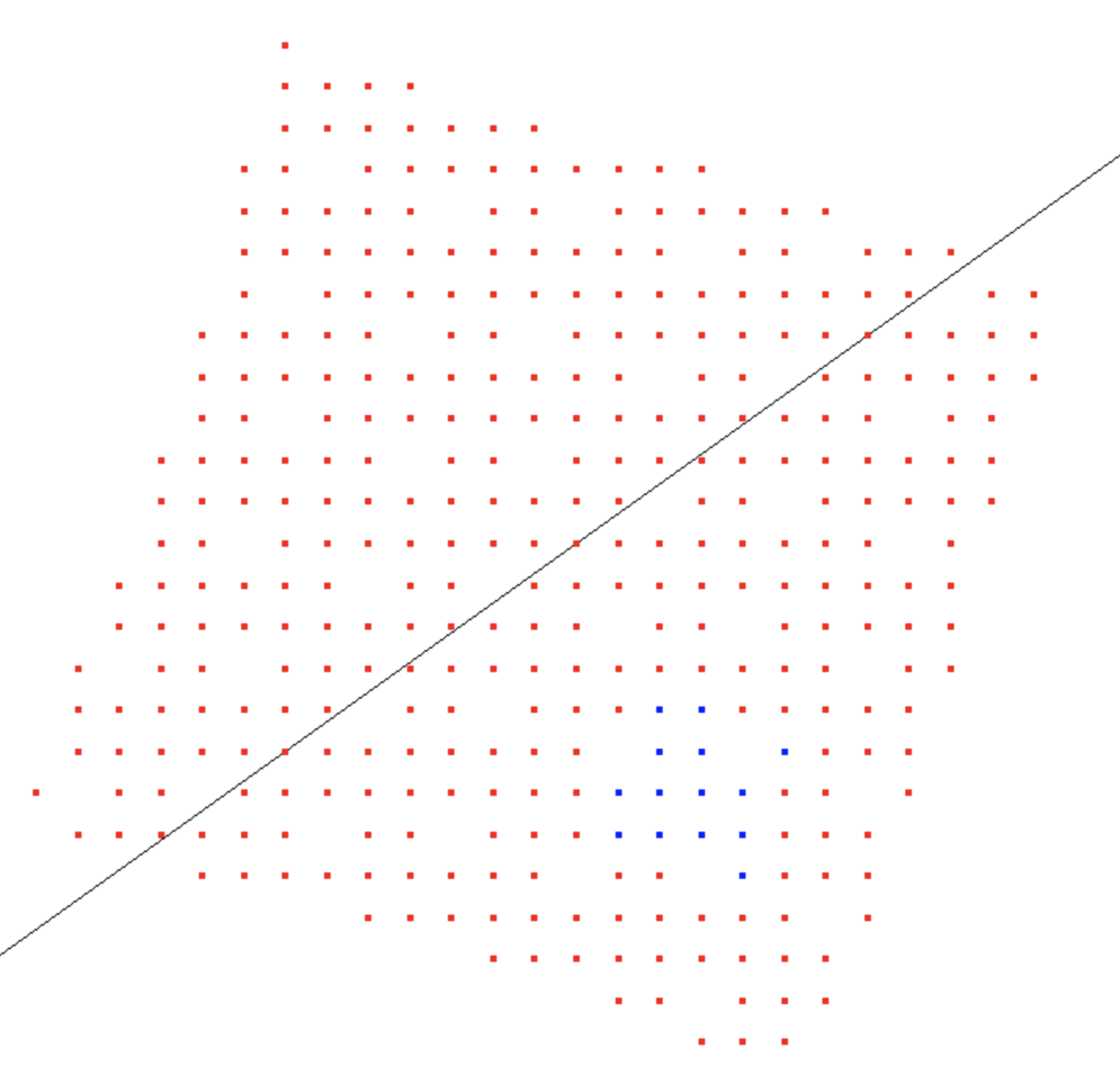
\( \bullet \) Réflexions \( \mathcal{U}^{m} \)
\( \bullet \) Opérateur digital \( \mathcal{D} \)
\( \bullet \) Réflexions digitales \( \mathcal{R}^{\mathbf{m}}\)
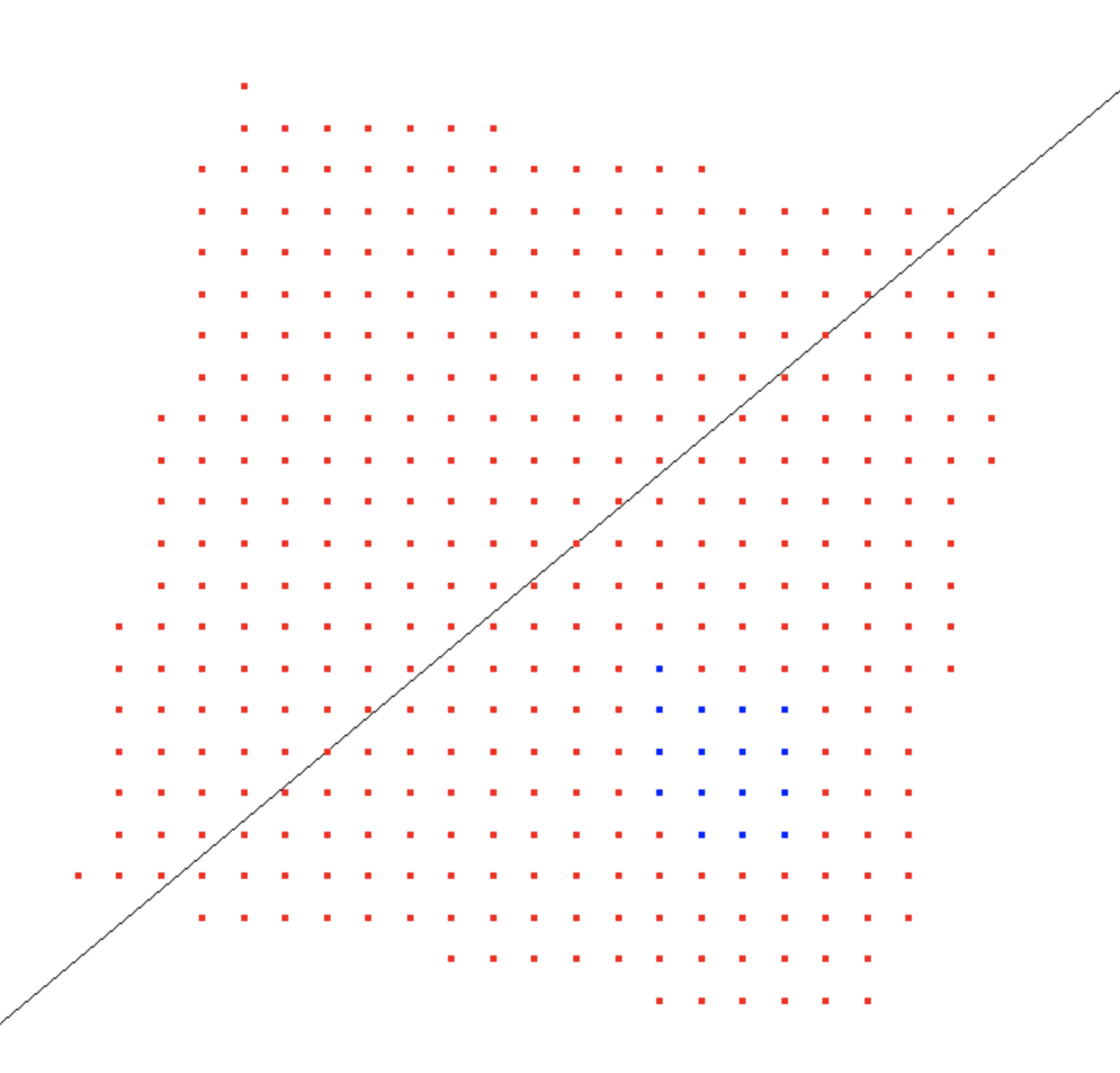
\( \mathbf{m}_b \) : réflexions digitales bijectives
\(\Leftrightarrow \) \(-\mathbf{e}_1 \mathbf{m}_b \mathbf{e}_1^{-1}\) est aussi une reflexion digitale bijective
\(\Leftrightarrow \) \(-\mathbf{e}_1 (a \mathbf{e}_1 + b \mathbf{e}_1) \mathbf{e}_1^{-1} \) est aussi une reflexion digitale bijective
\(\Leftrightarrow \mathbf{e}_1 \mathbf{m}_b \mathbf{e}_1^{-1} \mathbf{x} \mathbf{e}_1 \mathbf{m}_b^{-1} \mathbf{e}_1^{-1} \)
\(\Leftrightarrow (\mathbf{e}_1 \mathbf{m}_b) (\mathbf{e}_1^{-1} \mathbf{x} \mathbf{e}_1) (\mathbf{e}_1 \mathbf{m}_b) ^{-1} \)
reflexion de \(\mathbf{x} \) par rapport a l'axe \( \mathbf{e}_2\)
\(\Leftrightarrow (\mathbf{e}_1 \mathbf{m}_b) (\mathbf{e}_1^{-1} \mathbf{x} \mathbf{e}_1) (\mathbf{e}_1 \mathbf{m}_b) ^{-1} \)
\( \mathbf{e}_1 (a \mathbf{e}_1 + b \mathbf{e}_2) = a + b \mathbf{e}_{12}\)
\( \rightarrow \)homogène à l'entité effectuant la rotation en algèbre géométrique
\( \mathbf{m}_b = (k+1) \mathbf{e}_1 + k \mathbf{e}_2, k\in \mathbb{N} \)
réflexions digitales bijective
rotations digitales bijectives
\( \mathbf{m} = -(k+1) \mathbf{e}_1 + k \mathbf{e}_2, k\in \mathbb{N} \)
Entrée : réflexion non nécessairement bijective
Problème : trouver la plus "proche" réflexion bijective
Approximation
Réflexion digitale \( \mathbf{m} \)
Approximation bijective \( \widetilde{\mathbf{m}} \)
\( \bullet \)Composition d'une reflexion digitale (axe \( \mathbf{e}_{1} \)) et d'une reflexion digitale bijective
\(\rightarrow \)rotation digitale bijective
\( \bullet \)Composition de 2 réflexions digitales bijectives
\( \rightarrow \) approximation bijective d'une rotation digitale
\( \hookrightarrow \) Approximer une rotation Euclidienne d'angle \( \theta\) à partir de 2 réflexions bijectives
\( \bullet \) Contrainte: angle entre les 2 vecteur normaux est \( \frac{\theta}{2} \)
où \( \theta\) est l'angle de rotation
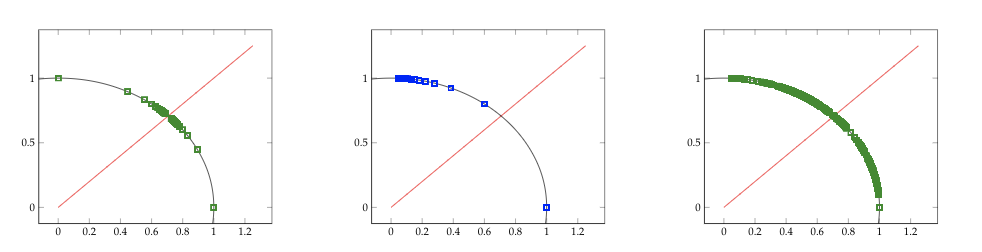
\( \bullet \) Etant donné \( k_{\max} \) et \(\mathbf{B}_{k_{\max}} \) (reflexions bijectives)
\( \bullet \) Boucler sur les réflexions digitales bijectives \( \mathbf{m}_{1} \in \mathbf{B}_{k_{\max}} \)
\( \bullet \) Chercher \( \mathbf{m}_{2} \) tel que l'angle entre \(\mathbf{m}_{1} \) et \(\mathbf{m}_{2} \) soit le demi angle de rotation.
\( \bullet \) Retourner le couple \( \mathbf{m}_{1},\mathbf{m}_{2} \) dont l'angle relatif est le plus proche de \( \frac{\theta}{2} \)
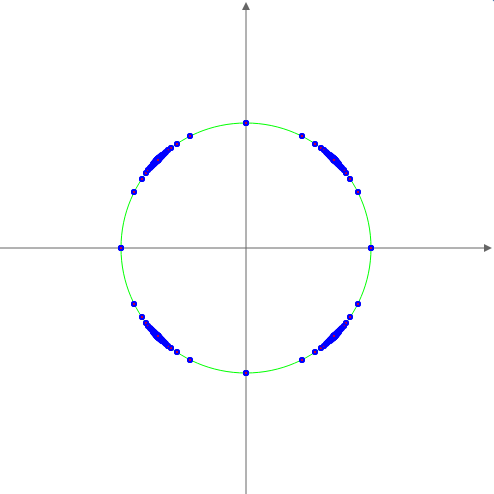
Réflexions digitales bijectives
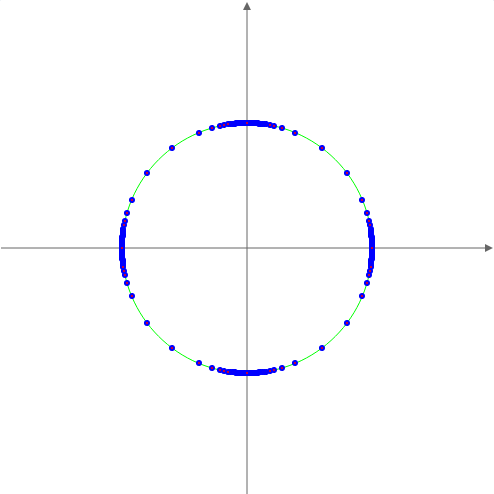
Rotations digitales bijectives
Rotations digitales bijectives par 2 réflexions digitales bijectives
\( \hookrightarrow \) plus de rotations digitales bijectives
\( \hookrightarrow \) méthode simple
\( \hookrightarrow \) peut etre étendue ...
\( \hookrightarrow \) comparaison des principales méthodes de rotations bijectives
quasi-shears, FFT, rotations à partir de reflexions bijectives à droites digitales (Andres), ...
By Stephane Breuils
slides in French about digital reflections and digital rotations with geometric algebra